Blood Moon Tonight? What Scripture Says & When It's Next
The moon turned to blood is one of the oldest signs in the Bible — and a real event you can watch from your own back yard, if you know when to look.
The Enoch Calendar lists every upcoming lunar eclipse with its exact date and time — and, once you set your location, tells you whether the next blood moon will be visible from your own city and where to look for it.
Open the calendar →Inside, open Upcoming — every eclipse for the next year is already listed. (Full walkthrough below.)
↓ A sample from the calendar
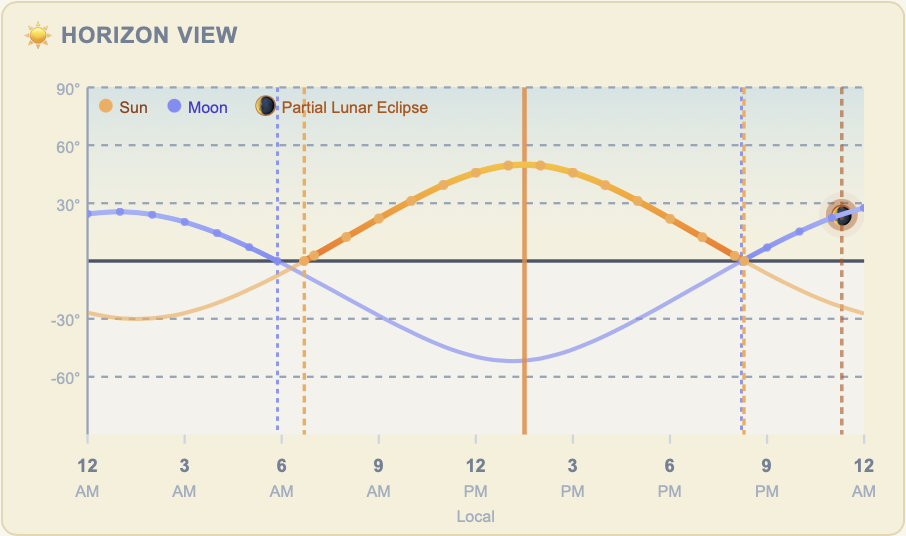
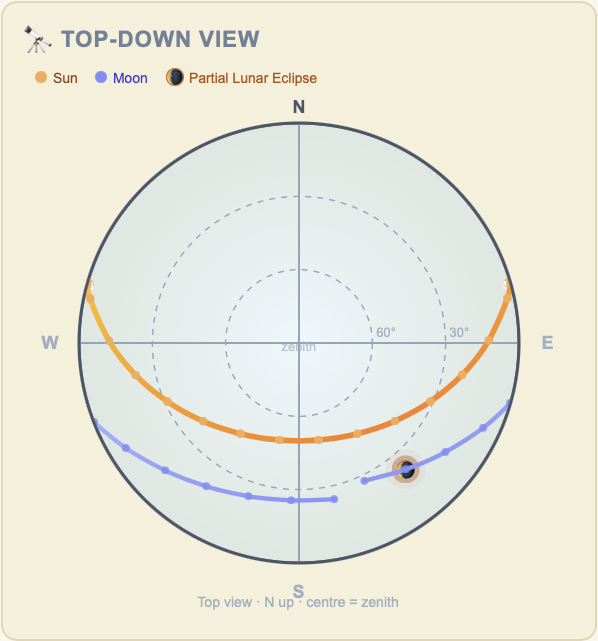
What a blood moon is
A blood moon is a total lunar eclipse — the moment the earth passes directly between the sun and the moon, and the moon slips fully into the earth's shadow. Instead of going dark, it turns a deep coppery red. The colour is real, not a trick of the eye: sunlight bends through the ring of the earth's atmosphere and falls on the moon's face, carrying the red of every sunrise and sunset on earth at once and casting it across the moon.
It is a striking thing to see, and Scripture has its own name for the sight. Long before anyone described the mechanics of an eclipse, the prophets called it plainly: the moon turned to blood.
The moon was set as a sign
From the fourth day of creation, the moon was given a purpose beyond lighting the night.
"And God said, Let there be lights in the firmament of the heaven... and let them be for signs, and for seasons, and for days, and years." — Genesis 1:14
The lights of heaven were appointed as signs — markers set in the sky to be read. The Psalms return to the same idea, naming the moon among the ordained works of God, a fixture as faithful and enduring as the covenant itself:
"He appointed the moon for seasons." — Psalm 104:19
"It shall be established for ever as the moon, and as a faithful witness in heaven." — Psalm 89:37
So when the moon does something unusual — when it darkens, or turns to blood — Scripture does not treat it as an accident of nature. It treats it as the sign it was made to be.
The moon turned to blood
The image runs from the prophets, through the apostles, to the final vision of Revelation — always tied to the day of the LORD.
"The sun shall be turned into darkness, and the moon into blood, before the great and terrible day of the LORD come." — Joel 2:31
Peter takes up Joel's words on the day of Pentecost, applying them to the age that had just begun:
"The sun shall be turned into darkness, and the moon into blood, before that great and notable day of the Lord come." — Acts 2:20
John sees the same sign opened as the sixth seal:
"And I beheld when he had opened the sixth seal, and, lo, there was a great earthquake; and the sun became black as sackcloth of hair, and the moon became as blood." — Revelation 6:12
And Jesus himself points to the heavens as the place to watch:
"And there shall be signs in the sun, and in the moon, and in the stars." — Luke 21:25
Whatever else these passages hold, they share one instruction: the moon is a sign, and a darkened or blood-red moon is a sign worth noticing. That is reason enough to know when the next one falls.
When is the next blood moon — and will you see it?
A total lunar eclipse doesn't happen every night — only a handful of times a year — so the real question is usually whether tonight, or whatever night you have in mind, is one of them, and at what time. Even then, not every blood moon is visible everywhere: a lunar eclipse can only be seen from the half of the earth facing the moon at that hour, so whether you will see it depends entirely on where you stand on the globe. The calendar works this out for you — it knows the dates and times of the upcoming eclipses, and whether each one rises above your own horizon.
How to see it in the calendar
- Open the free web calendar and click Upcoming.
- Every upcoming lunar eclipse for roughly the next year is listed there already. Until you set a location, each one shows “Set your location to see if visible” — click that line, and within a couple of seconds every eclipse updates.
- Each eclipse then tells you directly: a green line means it is above the horizon and visible from your city; a grey line means it falls below your horizon there.
- Click any eclipse in the list to jump straight to that day on the calendar for the full detail — the exact time, and the Horizon View and Top-Down View shown above.
About your location: setting it uses only your approximate, city-level location — not GPS, not your exact position — and it is used for one thing: working out whether each eclipse is above your horizon. That is all it is for.
Open the calendar →Every lunar eclipse from 2026 to 2035
Not every lunar eclipse is a blood moon — and none is visible from the whole world at once. Each can be seen only from the half of the earth facing the moon at that hour. Here is the full run of lunar eclipses for the next decade: which are total (the blood moons), which are partial or penumbral, and the world regions each one is visible from. Eight of the 23 are blood moons (total eclipses).
The regions below are broad — open the calendar to see whether an eclipse is visible from your exact city.
| Date | Day | Type | Mag. | Greatest eclipse | Where it’s visible |
|---|---|---|---|---|---|
| Mar 3, 2026 | Tue | 🔴 Blood Moon | 1.15 | 11:36 UT | N. America, Asia, Australia, Pacific |
| Aug 28, 2026 | Fri | 🌘 Partial | 0.93 | 04:12 UT | N. America, S. America, Europe, Africa |
| Feb 20, 2027 | Sat | ◑ Penumbral | — | 23:12 UT | N. America, S. America, Europe, Africa, Middle East, Asia |
| Jul 18, 2027 | Sun | ◑ Penumbral | — | 16:06 UT | Africa, Middle East, Asia, Australia, Pacific |
| Aug 17, 2027 | Tue | ◑ Penumbral | — | 07:12 UT | N. America, S. America, Australia, Pacific |
| Jan 12, 2028 | Wed | 🌘 Partial | 0.07 | 04:12 UT | N. America, S. America, Europe, Africa, Middle East, Pacific |
| Jul 6, 2028 | Thu | 🌘 Partial | 0.39 | 18:18 UT | Africa, Middle East, Asia, Australia, Pacific |
| Dec 31, 2028 | Sun | 🔴 Blood Moon | 1.25 | 16:54 UT | N. America, Europe, Africa, Middle East, Asia, Australia, Pacific |
| Jun 26, 2029 | Tue | 🔴 Blood Moon | 1.84 | 03:24 UT | N. America, S. America, Europe, Africa |
| Dec 20, 2029 | Thu | 🔴 Blood Moon | 1.12 | 22:42 UT | N. America, S. America, Europe, Africa, Middle East, Asia |
| Jun 15, 2030 | Sat | 🌘 Partial | 0.50 | 18:36 UT | Africa, Middle East, Asia, Australia |
| Dec 9, 2030 | Mon | ◑ Penumbral | — | 22:30 UT | N. America, S. America, Europe, Africa, Middle East, Asia |
| May 7, 2031 | Wed | ◑ Penumbral | — | 03:54 UT | N. America, S. America, Europe, Africa |
| Jun 5, 2031 | Thu | ◑ Penumbral | — | 11:48 UT | N. America, Asia, Australia, Pacific |
| Oct 30, 2031 | Thu | ◑ Penumbral | — | 07:48 UT | N. America, S. America, Australia, Pacific |
| Apr 25, 2032 | Sun | 🔴 Blood Moon | 1.19 | 15:12 UT | Middle East, Asia, Australia, Pacific |
| Oct 18, 2032 | Mon | 🔴 Blood Moon | 1.10 | 19:06 UT | Europe, Africa, Middle East, Asia, Australia |
| Apr 14, 2033 | Thu | 🔴 Blood Moon | 1.09 | 19:12 UT | Europe, Africa, Middle East, Asia, Australia |
| Oct 8, 2033 | Sat | 🔴 Blood Moon | 1.35 | 10:54 UT | N. America, Asia, Australia, Pacific |
| Apr 3, 2034 | Mon | ◑ Penumbral | — | 19:06 UT | Europe, Africa, Middle East, Asia, Australia |
| Sep 28, 2034 | Thu | 🌘 Partial | 0.01 | 02:48 UT | N. America, S. America, Europe, Africa, Middle East |
| Feb 22, 2035 | Thu | ◑ Penumbral | — | 09:06 UT | N. America, S. America, Asia, Australia, Pacific |
| Aug 19, 2035 | Sun | 🌘 Partial | 0.10 | 01:12 UT | N. America, S. America, Europe, Africa, Middle East |
🔴 Blood Moon = total eclipse (moon turns red) · 🌘 Partial = part of the moon darkens · ◑ Penumbral = a faint shading, subtle to the eye
Mag. = umbral magnitude (1.0 or more = total) · Greatest eclipse is in Universal Time (UT); convert to your zone — e.g. US Eastern is UT−5, US Pacific UT−8, Central Europe UT+1
Where it’s visible lists broad world regions — not individual cities — where the moon is above the horizon at greatest eclipse. Near a region’s edge the moon may be up for only part of a long eclipse, at moonrise or moonset. For your own city and exact times, open the calendar — it works out visibility for your precise location.
A sign, not a spectacle
Scripture treats the darkened moon as a sign pointing beyond itself — to the day of the LORD — not as a date to be decoded or a countdown to be feared. The same book that names the moon a sign also warns against making too much of it: the heavens were given to be read, not worshipped.
"And lest thou lift up thine eyes unto heaven, and when thou seest the sun, and the moon, and the stars... shouldest be driven to worship them." — Deuteronomy 4:19
So the aim here is simple and unsensational: to know when a sign the Bible names is actually in the sky, and to be among those watching when it is.
The eclipse dates above are computed by the Enoch Calendar — a reconstruction of the 364-day solar year of Scripture, with its feasts, its seasons, and where today falls on it.
Explore the Enoch Calendar →Common questions
What is a blood moon?
A blood moon is a total lunar eclipse — the moment the moon passes fully into the earth's shadow and turns a deep red instead of going dark, as sunlight bends through earth's atmosphere onto its face. Scripture names this same sight directly: the moon turned to blood (Joel 2:31, Acts 2:20, Revelation 6:12).
What does a blood moon mean in the Bible?
In scripture, the moon was set as a sign from creation (Genesis 1:14). Joel 2:31 and Acts 2:20 describe the moon turning to blood before the day of the LORD, and Revelation 6:12 repeats the same image. The Bible treats it as a sign to be noticed, not a date to be feared or decoded.
When is the next blood moon?
The Enoch Calendar's free web calendar lists upcoming lunar eclipses roughly a year ahead in Upcoming, each with its exact date and time — and, once you set your location, whether it will be visible from where you are.
Is there a blood moon tonight?
Not on most nights — a total lunar eclipse only happens a few times a year, unlike an ordinary full moon. The Enoch Calendar's free web calendar can tell you whether tonight, or any specific night, is one of them, and whether it will be visible from your location.
What time does a blood moon happen?
The exact time depends on the specific eclipse and your time zone. The Enoch Calendar's free web calendar shows the precise date and time of greatest eclipse for each upcoming lunar eclipse, alongside whether it rises above your own horizon.
How do I know if a blood moon is visible from my location?
A lunar eclipse is only visible from the half of the earth facing the moon at that hour. In the Enoch Calendar's free web calendar, open Upcoming — every upcoming eclipse is already listed. Click the 'Set your location to see if visible' line on any of them, and each eclipse is then labeled visible or not from your city; open one to see the exact direction and height to look.
Which lunar eclipses are visible from North America?
Of the 23 lunar eclipses between 2026 and 2035, 16 are visible at least in part from North America, including five blood moons (total eclipses). This page lists them all with dates, times, and type. Not every lunar eclipse is a blood moon — many are partial or penumbral — and not every one is visible everywhere, since a lunar eclipse can only be seen from the night side of the earth at that hour.
Does a blood moon mean the end times are near?
Scripture treats the darkened moon as a sign pointing beyond itself, to the day of the LORD — not as a date to be decoded or a countdown to be feared. The same book that names the moon a sign also warns against making too much of it: the heavens were given to be read, not worshipped, and Deuteronomy 4:19 cautions against being driven to worship the sun and the moon and the stars. So the aim here is simple and unsensational: to know when a sign the Bible names is actually in the sky, and to be among those watching when it is.
Sources
Scripture quotations are from the King James Version (public domain). Eclipse dates, times, and visibility are computed by the Enoch Calendar from astronomical data for the location you provide. The reddening of the eclipsed moon is refracted sunlight through the earth's atmosphere — standard astronomy, described here in the plain terms the biblical text uses.